By Shannon Larson and Camilo Fonseca Globe Staff,Updated July 28, 2025, 2:38 p.m.
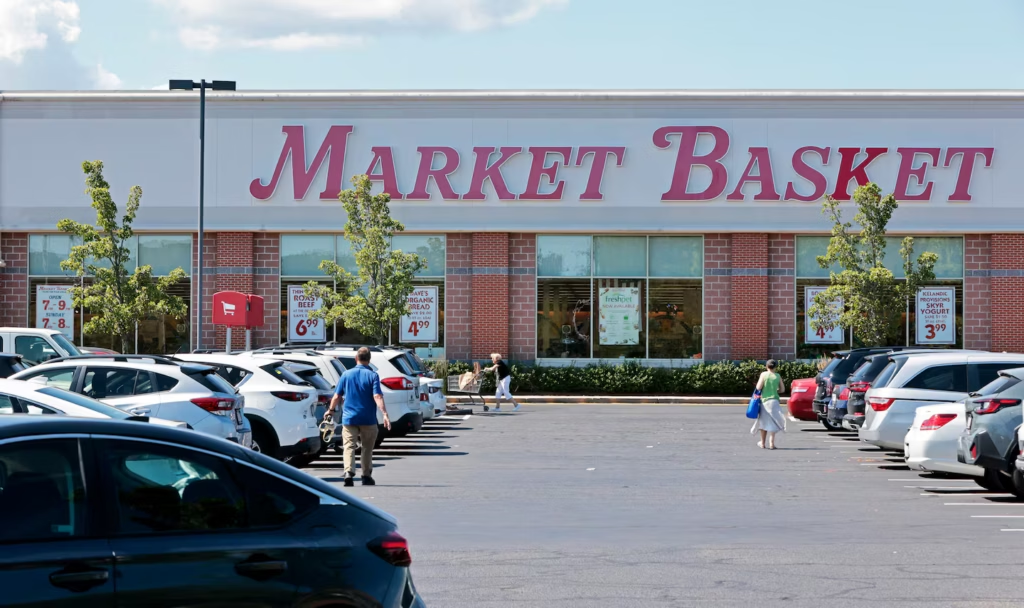
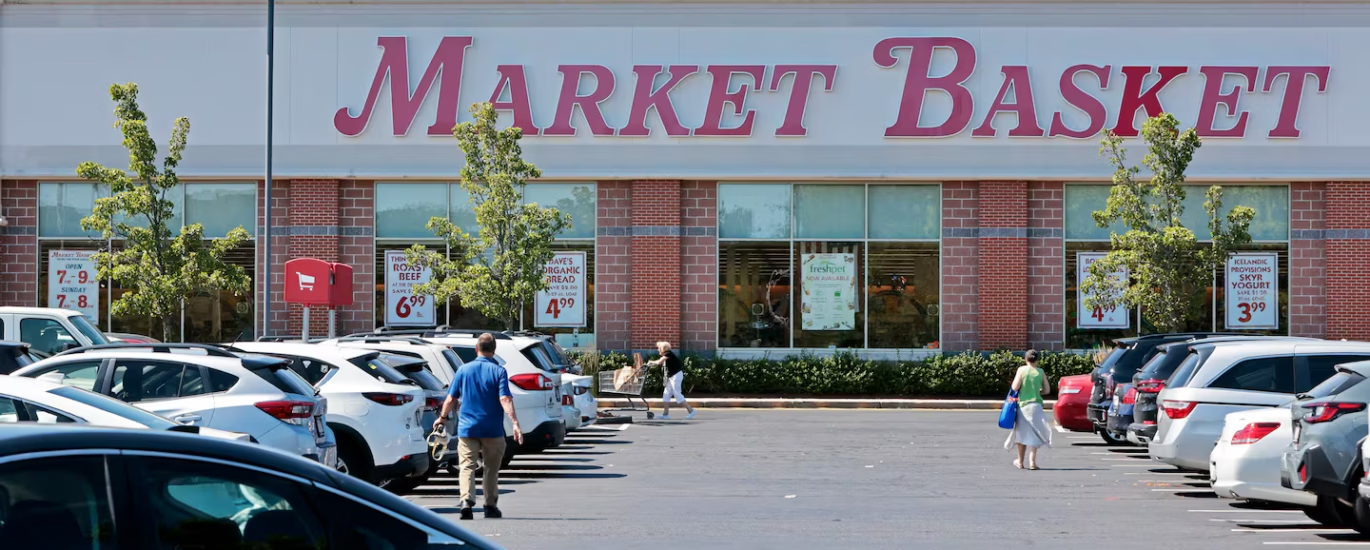
The Market Basket in Reading. Pat Greenhouse/Globe Staff
Dozens ofMarket Basket employees have been suspended from the grocery chain’s New Bedford store over the past week after recent operations by federal immigration officials, the head of an advocacy group for immigrant workers said Friday.
The suspensions have affected 48employees, according to Adrian Ventura, executive director of Centro Comunitario de Trabajadores, a nonprofitin New Bedford.
A spokesperson for Market Basket said the employees were suspended in connection with a Department of Homeland Security investigation that dated back to 2023. The employees will “have an opportunity to be reinstated pending updating their working papers,” the spokesperson added.
Immigration authorities ordered an I-9 audit of the store in 2023, but it was paused by the US Department of Labor, Ventura said. In an I-9 audit, businesses turn over employees’ Employment Eligibility Verification forms to investigators, who check for compliance, according to US Immigration and Customs Enforcement.
The Market Basket spokesperson said DHS investigated the employees’ paperwork and “recently found several had not been properly updated, leading to their suspensions.”
“Market Basket looks forward to welcoming the employees back to work as soon as they update their paperwork,” the spokesperson said.
A representative from DHS could not immediately be reached for comment about the 2023 probe.
A spokesperson for ICE declined to comment, citing the ongoing investigation.
The suspensions were first reported by the New Bedford Light.
Store employees were asked to present their work authorization documents at a recent meeting with management, Ventura said. The meeting was held after workers observed ICE activity in the grocery store’s parking lot, although agents were not seen entering the store, he said.
Several employees lacking work permits have since been suspended indefinitely, he said.
Ventura said many held valid permits when they were first hired, but the permits had since lapsed. It’s unclear if any of the workers held Temporary Protected Status, or TPS, a legal status that has been revoked by the Trump administration for immigrants from several countries.
For the workers, many of whom Ventura said had worked at the store for more than a decade, the situation is “very difficult.”
”There are mothers that have three or four kids, single mothers,“ he said in an interview conducted in Spanish. ”One mother [who was suspended], her husband was caught up in an immigration raid while working construction and was deported. Now she’s in limbo … It’s a complete disaster.”
Jonathan Darling, a New Bedford city spokesperson did not comment directly on the suspensions but said, “with respect to the federal government’s approach to the enforcement of immigration law, the mayor [Jon Mitchell] has made clear that the focus should be on known criminals or others who pose public safety risks.”
Since President Trump took office, promising mass deportations and crackdowns on undocumented immigrants, thousands of undocumented immigrants have been detained and many others deported.
An estimated 200,000 undocumented immigrants live in Massachusetts, with approximately 10,000 living in the New Bedford area. About one-fifth of the city‘s more than 100,000 residents are foreign-born.
Many immigrant workers in New Bedford are originally from Central America, Ventura said, as well as other parts of Latin America and Cape Verde. He added that immigrants are the backbone of the local fishing industry, which is central to New Bedford’s economy.
If work authorization crackdowns continue, it could spell danger not just for the immigrant community but for the entire city, Ventura said.
“There’s a saying that goes, ‘Take away his water, and the fish dies,’” he said. “Our concern is that if immigration officials start throwing I-9s at all the companies and agencies here, it will be a complete disaster here in New Bedford.”
In 2007, New Bedford was the scene of the largest workplace raid in the state‘s modern history, when federal immigration agents swarmed a local garment factory and arrested more than 300 undocumented immigrants. The raid had lasting implications on the city.
I-9 audits are not new, said Boston-based immigration attorney Matthew Maiona, but there has been an uptick since Trump took office. Also known as “silent raids,” audits are among the enforcement mechanisms used to check that businesses are employing people who are legally authorized to work in the country.
Such inspections are typically prompted by an outside complaint or an internal investigation, and the process begins when an employer is served with a Notice of Inspection, requiring a review of all employee I-9 forms.
While Maiona was unfamiliar with the Market Basket case, he said the company was likely not knowingly bypassing the law, but was among the many employers nationwide caught up in the Trump administration’s fast-evolving immigration policies.
“We have people working who maybe had employment authorization cards through temporary protected status, or through a pending asylum application or deferred action, or through one of the many programs … that are now being deemed no longer available,” Maiona said. “It puts an exceptional onus on the employers to keep up with all of this.”
He noted that a massive pool of funding was recently allocated for immigration enforcement under Trump’s “big, beautiful bill,” including $45 billion for ICE to expand its detention system and another $30 billion for its arrest and deportation efforts.
“I don’t think it’s getting any better anytime soon,” Maiona said. “It’s only going to get worse from here.”
Nick Stoico of the Globe staff contributed to this report.